“Snowmageddon … Snovid-21 … Snowpocalypse”
What a mess!
Hell didn’t freeze over, but most of Texas did.
Here’s a moment of full disclosure: Mrs. Sweetie and I came through the last week pretty well. We had rolling electricity blackouts—averaging about an hour on and an hour off from 2:00 a.m. Monday until 6:00 p.m. Wednesday. The longest the power was off was about 3 hours.
Our water never went off and we had no frozen pipes or damage.
All in all, what we had were fairly minor inconveniences.
Some people had it bad and there are still messes to clean up.
I get it. I sympathize. The past year seems like one thing after another and everyone is weary.
But, it seems like we (collectively) have lost our way and our minds.
I got a Facebook invitation to join a group initiating a class action lawsuit before the temperature ever got out of the 20s!
I saw some of the most venomous posts (yes, I realize they were posted out of frustration, hurt, and fear) calling for “accountability” and “justice” in the midst of this craziness.
There are plenty of questions to ask and plenty of adjustments that need to be made, but we are heading toward problems far worse than weather, utility companies, and politicians if we can’t manage to get our collective outrage in check.
Several years ago, I wrote a book entitled “Culture Wars” in which I highlighted eight “cultural indicators” that I observed at the time.
Almost 18 years have passed since I started processing those observations and almost 6 years have passed since the latest revision of the book was published.
While a few specifics have changed, I have not observed anything to make me believe that those cultural indicators have done anything but multiply exponentially.
Case in point: I called one of the indicators the “Blame Game Culture.” See if these characteristics sound familiar to you at all (particularly against the background of the past week or so).
In the “Blame Game Culture” there is a passionate need to assign accountability. It’s not enough to determine what happened or even why it happened—someone has got to be blamed.
In the “Blame Game Culture” there is an overemphasis on punishment and retribution. It’s not enough to find out who is to blame; we also need to determine who is going to pay for the suffering they caused as well as the actual damages.
In the “Blame Game Culture” there is an inability to release bitterness until a personal sense of justice has been satisfied. It’s not enough to determine who is to blame and that they pay for the suffering they caused; we are unsatisfied until we think they have paid enough to experience some suffering themselves.
In the “Blame Game Culture” there is an alarming avoidance of personal responsibility. In our passionate need to assign blame and magnify the failures of others, we have a tendency to excuse our own failure to act wisely and responsibly—thereby living in a perpetual state of victimhood.
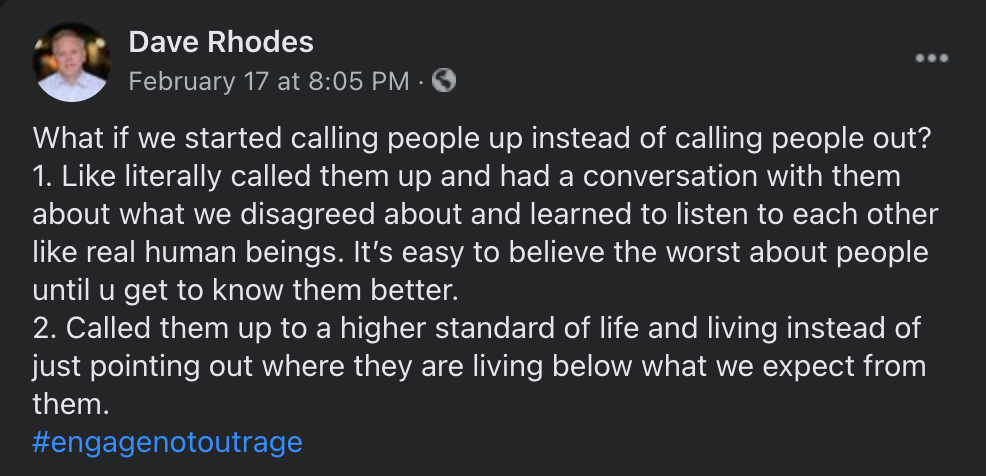
One of the best things I’ve seen written in the past few days was from my friend Dave Rhodes, who suggested that instead of calling people out, maybe we should call them up.
Certainly one part of that is calling them up to a higher standard of behavior (something we can’t do if we are not behaving that way ourselves).
But, more importantly, we should call them up into conversation. Talk TO people, not ABOUT them. Seek to observe and understand their own circumstances, rather than simply asking them to focus on ours.
Our journey to Amazing will be filled with detours and unscheduled stops.
Let’s remember that nobody has all the answers and nobody always gets it right. But there are far fewer people than we may imagine who are deliberately out to run us into the ditch.
When someone is in the ditch, it’s more important to help them get out than it is to figure out who’s to blame.
Be amazing today, my friend.
Here is the original post from Dave Rhodes:
Here’s your invitation to hop over to Amazon and pick up a copy of Culture Wars. Click on the book cover.